

Detonation of ammonium nitrate
- 24 Jun 2026
- 5 Minutes to read
Detonation of ammonium nitrate
- Updated on 24 Jun 2026
- 5 Minutes to read
Article summary
Did you find this summary helpful?
Thank you for your feedback!
Ammonium nitrate is widely used as a nitrogen-based fertiliser and as a raw material in industrial explosives. Under normal storage conditions, ammonium nitrate-based fertilisers are generally thermally stable and are not prone to self-heating; however, ammonium nitrate is a strong oxidiser and can support or intensify the combustion of other materials.
When heated, ammonium nitrate can melt and thermally decompose, producing toxic gases such as nitrogen oxides and ammonia. Under severe conditions, such as prolonged fire exposure, confinement at high temperature, contamination with combustible materials, or exposure to a strong initiating source, decomposition may accelerate and lead to detonation. This example demonstrates how to model the blast effects from a large ammonium nitrate warehouse explosion using EFFECTS.
Scenario
The scenario is based on a severe accident involving bulk storage of ammonium nitrate, where the material undergoes detonation following a major initiating event such as fire exposure, contamination, confinement, or shock. The objective of the calculation is to estimate overpressure effects and assess potential lethality.
Modelling approach
To set up your project file for the simulation of this scenario, you can follow the steps:
Add background. Define the context and environment for the simulation.
Add receivers (optional). Identify vulnerable areas on which overpressure effect will be evaluated.
Add equipment. Set the location of the ammonia release on the map [3953986, 4015561].
Select models.
Model selection
For this scenario, the Solid explosion model is selected using the TNT equivalency method.
The TNT equivalency method represents an explosion as an equivalent TNT charge, which is then used to calculate blast overpressure effects. According to the Yellow Book, the equivalent TNT charge can be defined in two ways:
Energy-based equivalency - The combustion energy of a fuel is converted into an equivalent TNT mass.
Mass-based equivalency - The mass of material involved is multiplied directly by a TNT equivalency factor.
For this ammonium nitrate detonation scenario, the mass-based TNT equivalency approach is selected. This is because the ammonium nitrate is modelled as a solid material undergoing detonation, rather than as a combustible vapour cloud. The equivalent TNT mass is therefore calculated directly from the ammonium nitrate mass and the selected TNT equivalency factor.
The Solid explosion model is suitable for this scenario because it represents explosions involving solid or condensed-phase materials that can generate a blast wave. In this case, the ammonium nitrate stored in the warehouse is assumed to detonate under severe accident conditions. The model is used to estimate the resulting blast overpressure contours and the effect at selected receiver locations.
Inputs
After adding the Solid explosion model under the Equipment node, define the required input parameters for the calculation.
Input parameter | |
|---|---|
Chemical name | AMMONIUM NITRATE (DIPPR) |
Type of TNT model | Based upon mass |
TNT equivalency factor (-) | 0,3 |
Mass of fuel involved (ton (metric)) | 2750 |
Offset between release and explosion centre (m) | 0 |
Predefined wind direction | W |
Pressure lethality based on | Threshold pressure level |
Peak pressure total destruction (Indoors+Outdoors) (mbar) | 300 |
Lethality total destruction (Indoors+Outdoors) (-) | 1 |
Peak pressure indoors (glass) lethality (mbar) | 100 |
Lethality indoors (glass) (-) | 0,025 |
Reporting/receiver distance (Xd) (m) | 250 |
Unsure what this parameter means?
Read more on the input parameters in the help file directly in EFFECTS. Right-click at the parameter’s name in EFFECTS input panel and select <Help>, to open the help file.
In addition to the model setup, vulnerable areas can be added to the analysis to evaluate the effects of overpressure at specific locations. To demonstrate this functionality, three hospitals located near the accident location are defined as vulnerable areas. The impact of the explosion overpressure is then evaluated at these locations.
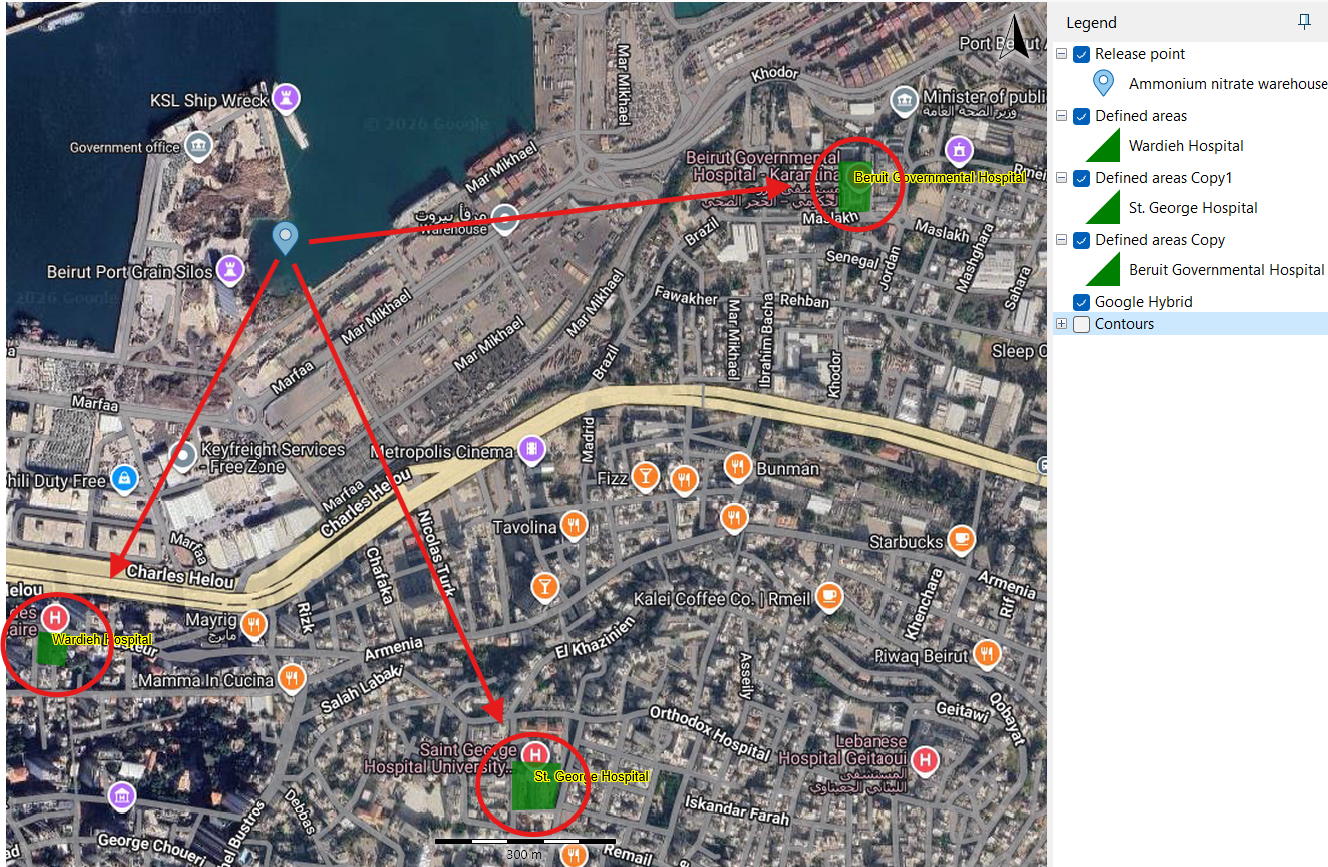
Vulnerable areas defined on map
Consequence results
After running the calculation, the results show the blast overpressure generated by the ammonium nitrate detonation and the corresponding damage distances.
The calculated overpressure contours provide the maximum effect distances for selected pressure levels. These can be viewed on a map.
The 300 mbar contour represents the area where total destruction is assumed in the vulnerability settings. In this scenario, this contour extends to approximately 584 m from the explosion centre.
The 100 mbar contour extends to approximately 1268 m. This pressure level is used in the model for indoor glass-related lethality and indicates a wider area where window breakage or minor structural damage may occur.
The 10 mbar contour extends to approximately 6939 m. In this distance people may hear a loud bang and feel pressure. Windows may rattle; very light glass damage possible in sensitive structures.
Based on the selected vulnerability settings, the 1% lethality corresponds to the same distance as the 300 mbar total destruction contour, because the selected vulnerability settings define lethality based on a threshold pressure level.
.png)
Overpressure and lethality contour reported by EFFECTS on map background
These hazard distances, together with other overpressure results at the defined reporting distance, are also available in the Reports tab.
In addition to map contours and tabulated results, the calculated explosion results can be reviewed in the Graphs tab. The graph view shows how the blast effects change with distance from the explosion centre. For example, the Overpressure vs Distance graph shows a steep decrease in overpressure close to the source, followed by a more gradual reduction at larger distances. This reflects the rapid decay of blast pressure as the shock wave propagates away from the explosion centre.
These graphs are useful for checking results at specific distances, comparing different scenarios, and explaining how damage levels change with distance from the warehouse.
Vulnerable areas show the calculated overpressure result at their defined locations and provide information on the expected number of fatalities due to the consequence effect considered in the model, which in this case is overpressure. In this example, no fatalities are reported. This indicates that the analysed vulnerable areas, represented by nearby hospitals, are located at a sufficient distance from the accident location. Based on the calculated overpressure levels, only minor to moderate damage is expected at these locations.
.png)
Blast effect on vulnerable areas presented in map view
Conclusion
This example shows how to model a large ammonium nitrate warehouse detonation in EFFECTS using the Solid explosion model with the mass-based TNT equivalency method.
The results provide overpressure and lethality contours, damage effects and effects at selected vulnerable areas. For this scenario, severe blast effects are predicted close to the explosion centre, while lower overpressure effects extend over larger distances.
The results depend strongly on the assumed ammonium nitrate mass, TNT equivalency factor, and vulnerability settings. These assumptions should therefore be clearly documented for project-specific assessments.
Download the project file
Explore the project file simulating the ammonia releases. Adjust map contours, select different graphs or multiple graphs at once, and evaluate how different hole sizes influence the received heat radiation dose. Inspect the receiver’s reports to assess the damage effect.
To view the project file, please open it using the EFFECTS software. If you do not have the software, you can download and use the free viewing demo version of EFFECTS via the link below.
References
PGS 2 (2025). Methods for the Calculation of Physical Effects due to Releases of Hazardous Materials (Liquids and Gases) (Yellow Book). The Hague: CPR.
Was this article helpful?